The OpenAPI editor
built for the agent era.
Design your API as a flow graph. Run any endpoint with one click. Hand the whole catalog to Claude or Cursor over OAuth. No CORS, no Docker, no hand-edited YAML.
THE LANDSCAPE
Six pillars. One editor.
Each one earned its way in by solving a real complaint we kept hearing.
Visual flow editor
Your spec, drawn as a node graph. Zoom, pan, and click any endpoint to edit.
One-click execution
Server-side proxy means no CORS. Run any endpoint from inside the editor.
Recipes
Chain up to 10 calls, map responses with JSONPath, assert on each step.
MCP server for AI
Claude, Cursor, VS Code, Windsurf can read and run your API catalog over OAuth.
Self-hosted proxy
One npx command tunnels your localhost & VPN services into the cloud editor.
Hosted docs & hotlinks
Publish a polished docs page in one click. Edge-cached on Cloudflare KV.
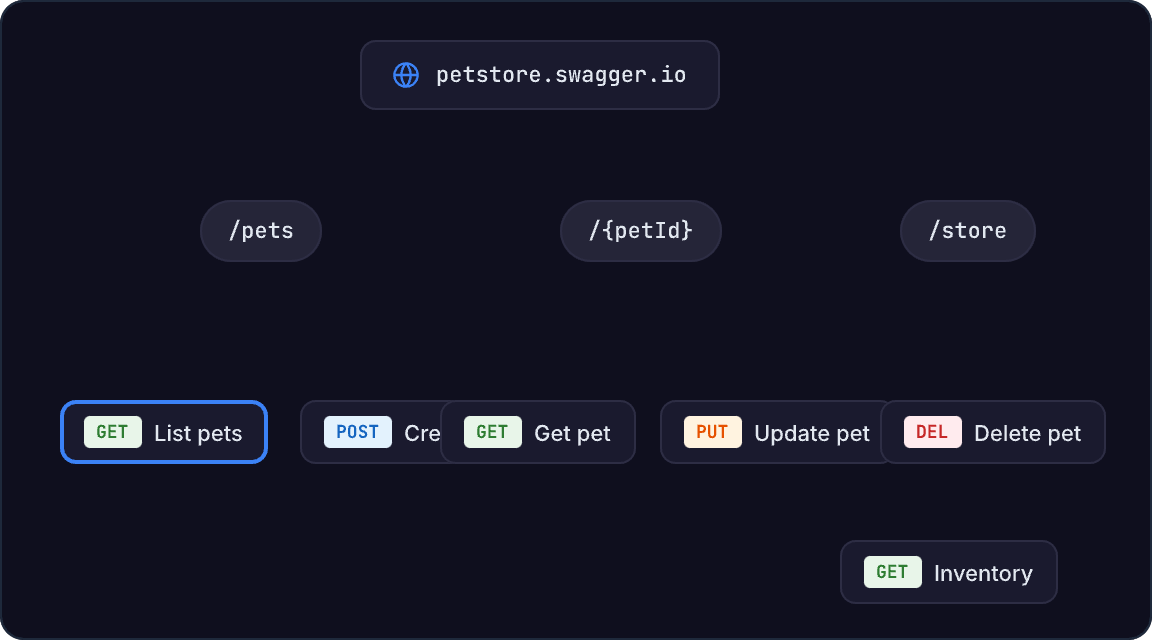
See your whole API at once
Every path becomes a node, every endpoint a leaf. Auto-layout untangles even a 300-endpoint spec into a graph you can read with your eyes.
- 4 layout algorithms: layered, stress, box, compact
- Click any endpoint to open the editor — no modal hopping
- Branch coloring keeps long path trees scannable
- Play button on every node — run without leaving the canvas
- Smooth performance on specs with 300+ operations
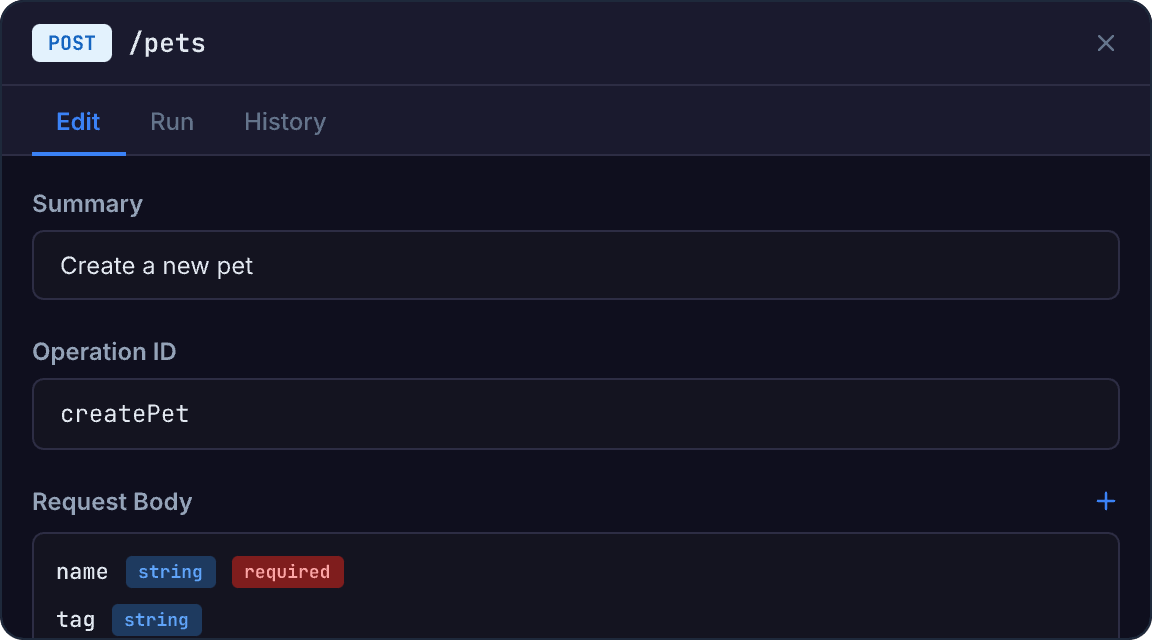
Edit every field. No YAML guessing.
Forms for everything OpenAPI 3.1 supports — info, servers, parameters, request bodies, responses, security, components. Drop into raw Monaco when you want code.
- Schema-driven forms — every field validated as you type
- Tabbed editor: Edit · Run · History on each operation
- Auto-save with full undo / redo stack
- Raw JSON / YAML mode with Monaco + formatter + JSONPath query
- Inline OpenAPI 3.0 → 3.1 conversion when you import
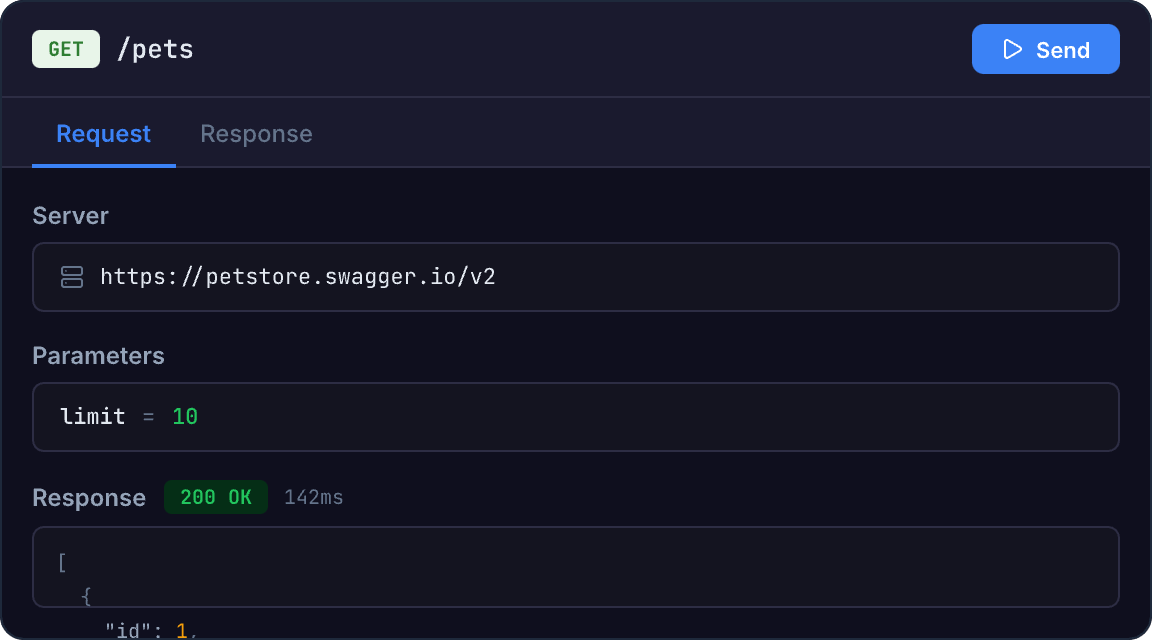
Hit send. Get a real response.
A server-side proxy makes CORS a non-issue. Pin responses you want to keep, and replay anything from the last 7 days (30 on Pro).
- Server-side proxy — no browser CORS dance
- Two-column run modal: request on the left, response on the right
- Response viewer with syntax highlighting and JSON tree
- Pin & save important responses — replay them later
- Browser fetch fallback when you want it client-side
Chain calls. Map responses. Assert.
Onboard a user, charge a card, send a webhook — in one runnable workflow. Pipe values between steps with JSONPath, watch progress stream live over SSE.
- Up to 10 chained API steps per recipe
- JSONPath response mapping ({`{{steps.1.userId}}`} style)
- Per-step assertions for validation
- Real-time progress over Server-Sent Events
- Stored on R2 — large response payloads stay outside D1
Hand your API catalog to Claude.
Every workspace ships with an MCP server. Claude Desktop, Cursor, VS Code, Windsurf — sign in once over PKCE OAuth and the agent can search, read, update, create, analyze, and run your endpoints.
6 tools, no plumbing
search · get · create · update · analyze · run — exposed automatically.
OAuth-first, no static tokens to leak
PKCE flow with discovery & DCR. Tokens are per-token RBAC (viewer / editor).
Auto-published to AI Coach Registry
Your spec shows up in marketplace search the moment you publish.
One-click Connect dialog
Tabbed install snippets for every IDE. Server name = workspace-spec slug.
Rate-limited per plan
Free, Pro, Team tiers — no surprise bills, no abuse.
Test your private network from the cloud
One npx command opens a tunnel from your machine to the editor — so localhost, staging, and VPN-only services are reachable without ever leaving your network.
- npx openapi-studio-proxy — no Docker, no signup
- PKCE OAuth login — no static tokens to manage
- Reachability flags so you see which envs are live
- Process management with structured logs and ASCII banner
- Browser-fetch fallback when you don't want a tunnel
Publish docs in one click
Every workspace can publish a fully-styled docs page at api.openapi.studio/h/your-slug. Edge-cached on Cloudflare KV — sub-30ms reads worldwide. Or grab the raw JSON / YAML via the same URL.
- Polished docs page with try-it, code samples, and schema browser
- Edge-cached via Cloudflare KV — ~20ms global reads
- Custom slug URLs you can hand to anyone
- Private specs gated by access tokens
- CORS-enabled — Swagger UI, Redoc, Postman all just work
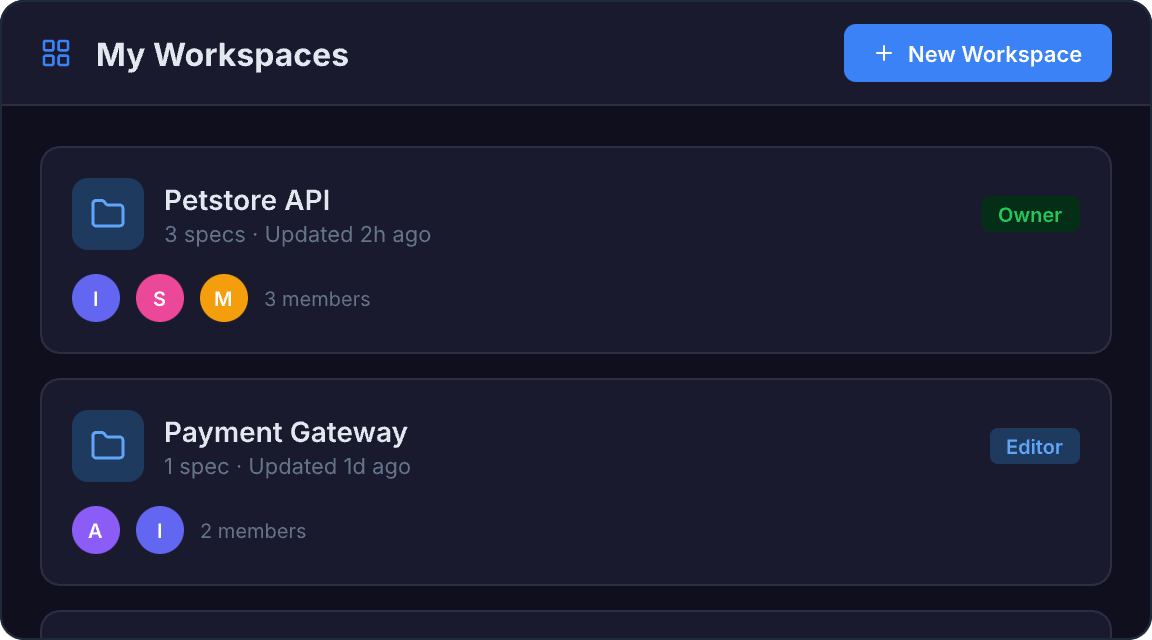
Real teams. Real roles.
Owner / Editor / Viewer with proper RBAC. Email invites, shared credential vault, multiple workspaces per account, and a real-time activity feed so nobody is in the dark.
- Owner / Editor / Viewer with hard-enforced RBAC
- Email invitations via hashed magic links
- Shared credential vault for API keys and bearer tokens
- Multiple workspaces per account, no extra cost
- Granular share & invite UI — kebab-menu, no scary buttons
See who did what — live
Every spec edit, recipe run, invitation, and MCP connection streams into the workspace feed in real time. Backed by Firestore so it survives page reloads and works across tabs.
- Real-time updates — no polling, no refresh button
- Persisted history per workspace, searchable
- Bottom-bar UI with online-collaborator presence
- Push notifications for high-signal events
- Pluggable event types — recipes, hotlinks, MCP, billing
Paste a cURL. Get a typed operation.
Stuck on YAML? Paste any cURL command from Stripe, Slack, your terminal — anywhere — and a centrally-managed prompt converts it into a fully-typed OpenAPI operation, headers, schema, and all.
- Drop in any cURL — REST, multipart, headers, anything
- Generates typed request body schema with required flags
- Centralized prompt management — versioned, A/B-tested
- Preview before adding to your spec — full edit path
- Powered by your Firebase GenAI quota — your tokens, your control
⌘K to anywhere
One palette. Endpoints, recipes, workspaces, schemas, settings — search across everything you have access to. Fuzzy matched, keyboard-driven, three-letters-fast.
- Searches across endpoints, recipes, schemas, and workspaces
- Method badges + workspace context on every result
- Keyboard-only — arrow keys, enter, escape
- Recents pinned to the top
- Permission-aware — you only see what you can open
Treat schemas like first-class citizens
See every reusable component, what references it, and which endpoints use it. Catch unused schemas before they rot, and click any $ref to jump straight to the definition.
- Used-by counts on every component
- Click any $ref to jump to the schema definition
- Detects orphaned schemas — safe to delete
- Inline property table with type, format, required, enum
- Response Log Viewer — captured payloads against schema
POWER TOOLS
And another dozen we sweat over.
The small stuff that adds up to a tool that doesn't get in your way.
Global Search
⌘K command palette across every workspace, spec, recipe, and endpoint.
Postman Import
Drop a Postman collection, get a fully-typed OpenAPI spec back.
Tree View Navigation
Sidebar tree with dropdown filters and rich state indicators.
Monaco Raw Editor
Full code editor for raw JSON/YAML with formatter and JSON-query.
Header Profiles
Save reusable User-Agent, auth, and custom header sets across requests.
Branch Coloring
Each path branch gets its own color so big specs read at a glance.
Onboarding Guide
Multi-step interactive walkthrough for brand-new users.
Spec Validation
Inline error display with line jumps for every OpenAPI 3.0 / 3.1 rule.
Push Notifications
Firebase-powered notifications for invites, runs, and shared updates.
Dark Mode
Full-spectrum dark theme tokens with system / manual toggle.
Stripe Billing
Plans, extension trials, coupons, webhooks, and admin audit log.
Admin Dashboard
Superadmin view for users, workspaces, plans, and system health.
UNDER THE HOOD
Boring infrastructure. Exciting product.
Edge-first, fully serverless, sub-second cold starts. We pick the load-bearing pieces and stay out of fashion.
Stop fighting your spec.
Start shipping it.
Free forever for solo developers. Two minutes to your first hosted spec.
No credit card · OAuth or password login · Migrate from Postman in one click